advertisement
Brain Implant Brings Simple Vision to Blind Man
Brain Implant Brings Simple Vision to Blind Man
NFK Editors - November 28, 2019Los Angeles, California —(Map)
When Jason Esterhuizen was 23, an accident left him blind. Now, eight years later, special glasses and a device inside his brain are allowing him to make out some details of the world around him.
When Mr. Esterhuizen had his accident in 2011, he was studying to be a pilot. But he had to give that up and focus instead on learning to deal with a world he couldn’t see.
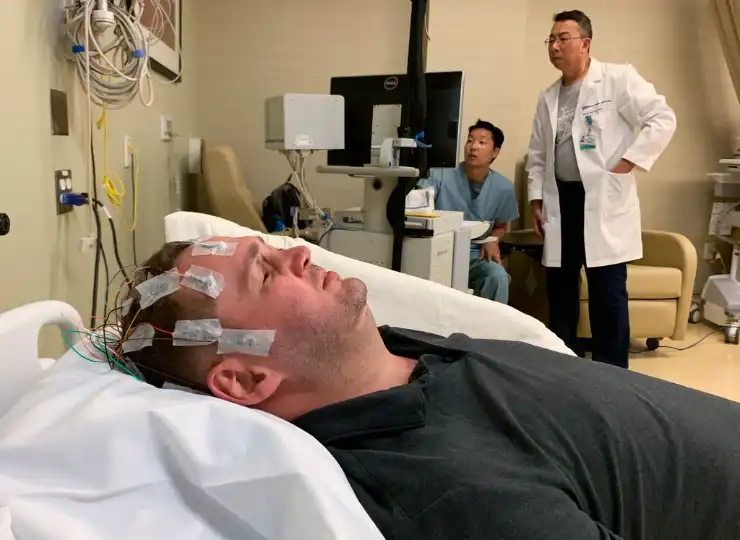
When Jason Esterhuizen was 23, an accident left him blind. Now special glasses and a device inside his brain are allowing him to make out some details of the world around him. The picture shows UCLA scientists checking Mr. Esterhuizen’s brain activity.
(Source: UCLA.)
He learned to read and write Braille – a system of writing created for blind people. He learned how to use a computer without seeing. And he learned how to get around as a blind person.
Mr. Esterhuizen is from South Africa. In 2018, he and his wife moved to California in order to take part in a study that offered the possibility of helping him with his vision.
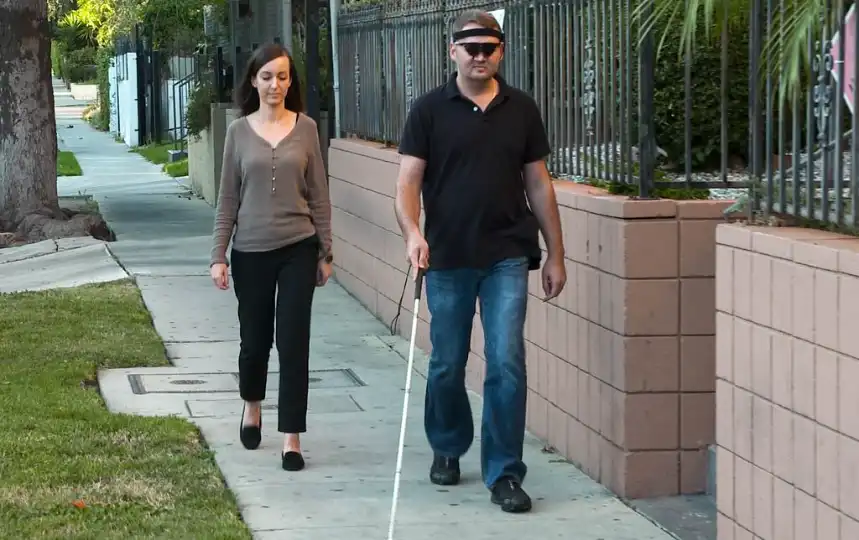
After his accident, Mr. Esterhuizen had to learn how to get around as a blind person. In 2018, he and his wife (above) moved to California in order to take part in a study that offered the possibility of helping him with his vision.
(Source: UCLA.)
The study was being run by UCLA (University of California, Los Angeles) and a company called Second Sight. The goal of the study was to test an unusual medical product called Orion.
There are three important pieces to Orion. One part looks like a pair of glasses. But the glasses are really for holding a camera on the person’s head. They also send wireless signals. The second part of Orion is a tiny computer that processes the video from the camera.
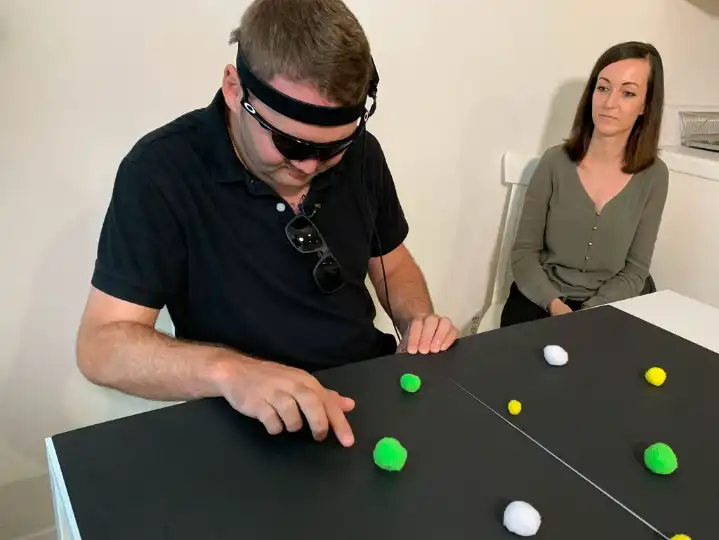
There are three important pieces to Orion. The glasses hold a camera and can send wireless signals. A tiny computer processes the camera’s video. And the brain implant receives signals from the glasses. Mr. Esterhuizen is shown practicing finding objects.
(Source: UCLA.)
So that’s where the “sight” comes from. But how does it get to the brain? The third part is a tiny device – an implant – that is inserted directly into the patient’s brain. That’s what’s new and different about Orion.
For years, Second Sight and other companies have been working on ways to get visual information into the brains of blind people. Most of the efforts have focused on connecting to the retina – a layer at the back of the eye that turns light into electrical signals for the brain.
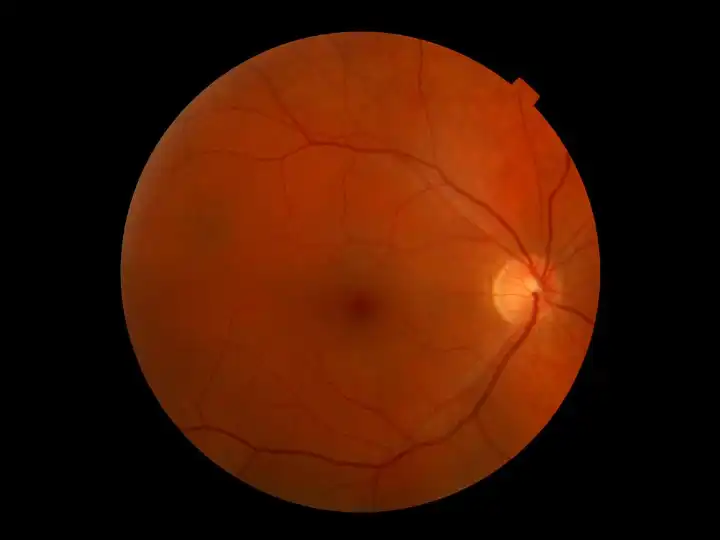
Most efforts to bring sight to blind people have focused on connecting to the retina – a layer at the back of the eye that turns light into electrical signals (above). The light circle to the right is where the optic nerve leaves the retina, taking vision information to the brain.
(Source: Alexander Churkin [CC BY 3.0], via Wikimedia Commons.)
By sending electrical signals to the retina, some visual information can be sent to the brain. So far Second Sight has given about 350 people retinal implants.
But a retinal implant wasn’t possible for Mr. Esterhuizen. That’s why Orion’s direct connection to the brain was especially interesting to him. As Dr. Nader Pouratian, the surgeon who gave Mr. Esterhuizen his implant, said, “With the current system we’re testing, you don’t even need to have eyes for the device to work.”
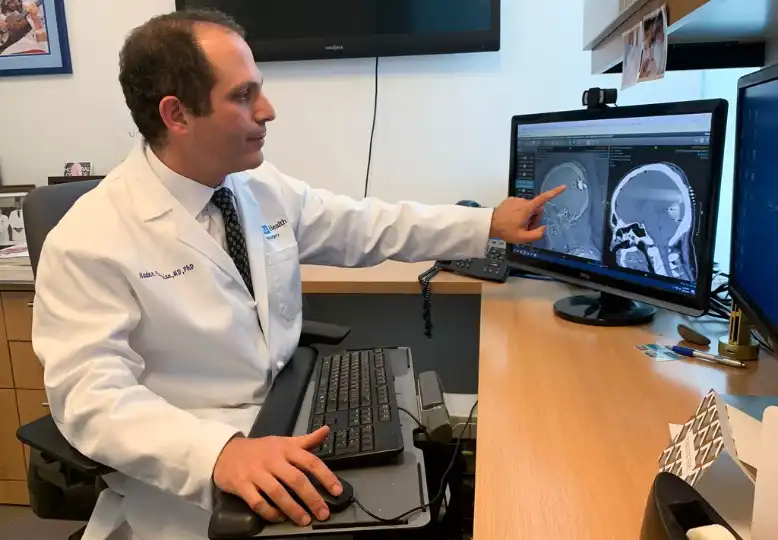
A retinal implant wasn’t possible for Mr. Esterhuizen. That’s why Orion’s direct connection to the brain interested him. Dr. Nader Pouratian, the surgeon who gave Mr. Esterhuizen his implant, said, “With the current system we’re testing, you don’t even need to have eyes for the device to work.” Above, Dr. Pouratian points to the location of the device.
(Source: UCLA.)
Mr. Esterhuizen’s vision isn’t “fixed”. He can’t see normally. But he can tell dark from light. He says he sees “little white dots on a black background, like looking up at the stars at night.”
There are six people in the world trying out the Orion. Mr. Esterhuizen is one of two in the US.
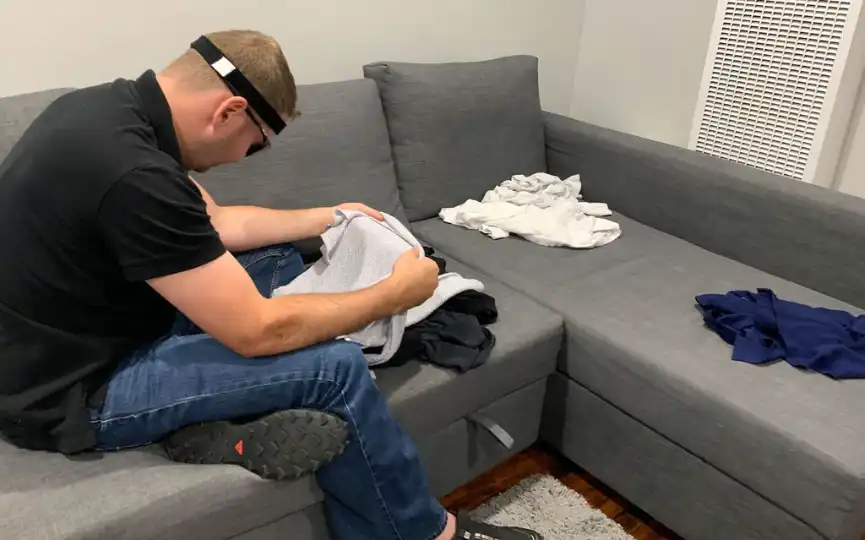
Mr. Esterhuizen’s vision isn’t “fixed”. He can’t see normally. But he can tell dark from light. “Now I can do things that I couldn’t do before,” he says. “I can sort the laundry, find my way in lighted hallways…and cross the street more safely. It’s making my life much easier.”
(Source: UCLA.)
“Now I can do things that I couldn’t do before,” Mr. Esterhuizen said. “I can sort the laundry, find my way in lighted hallways without using a cane, and cross the street more safely. It’s making my life much easier.”
Sourceswww.voanews.com
www.uclahealth.org
onezero.medium.com
www.insideedition.com
ucla.multimedia-newsroom.com
Los Angeles, California
View Larger MapShare:
In April, Lego announced a new project with its famous bricks: the company is making Braille bricks to help blind students learn to read, write, and do math.
Blind Sailor Sails Non-Stop Across the Pacific
NFK Editors - Apr 28, 2019
Mitsuhiro Iwamoto has been blind since he was 16. He wanted to prove that his blindness didn’t limit what he can do. Last week Mr. Iwamoto became the first blind person to sail non-stop across the Pacific Ocean.
You might be interested in…
Scientists Surprised by Clever Fishing Wolf
NFK Editors - Dec 3, 2025
In 2021, the Heiltsuk Nation in Canada set traps to catch invasive European green crabs. The traps kept getting destroyed, and no one knew how. When scientists set up a camera to learn what was going on, they got a surprise: a clever wolf had used a series of complicated steps to get food from the trap.
Pig Kidney Transplant Trial Begins in US
NFK Editors - Nov 12, 2025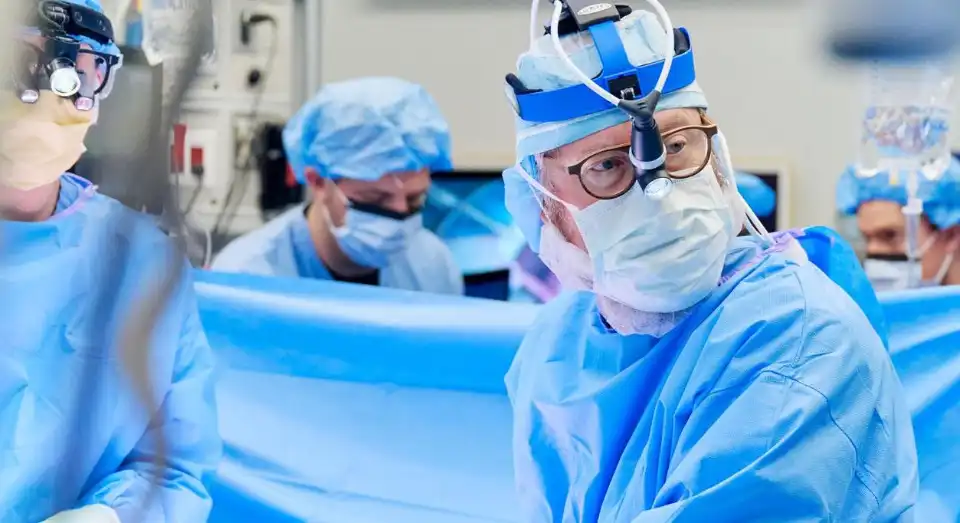
Doctors at a hospital in New York have begun a program that will test whether specially designed pig kidneys can be used to replace human kidneys. The results of the trial program could help thousands of people who are waiting for a new kidney.
ISS Celebrates 25 Years of People Living in Space
NFK Editors - Nov 6, 2025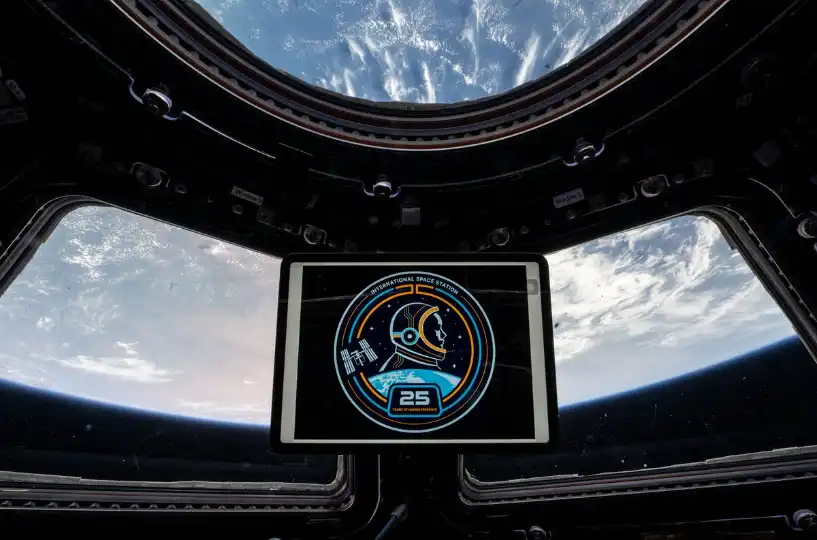
This week marks 25 years of humans living in space. On November 2, 2000, three astronauts became the first full-time workers at the International Space Station. Since then, the ISS has never been empty.
Is Seeing Believing? AI Videos Look Extremely Real
NFK Editors - Nov 5, 2025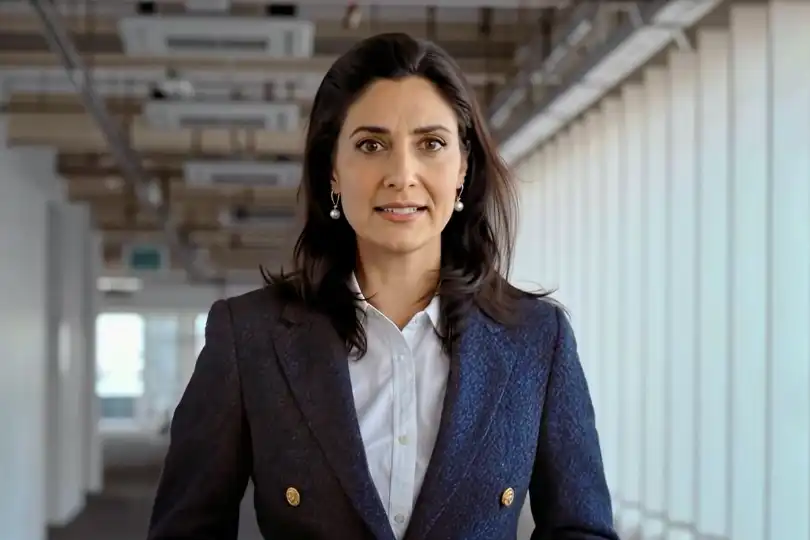
Over the last year or so, the quality of AI-generated videos has become so good that it’s extremely difficult to tell whether a video is real or not. An English TV channel recently ran a show about AI. At the end of the episode, the “woman” presenting the show announced that she wasn’t real.
advertisement