advertisement
SpaceX Completes Rocket Safety Test
SpaceX Completes Rocket Safety Test
NFK Editors - January 21, 2020Kennedy Space Center, Florida —(Map)
SpaceX, a company working to supply NASA with spacecraft, has successfully tested its emergency escape system. During the test, the part of the ship that holds people was safely carried away, while the main rocket exploded.
Like most rockets, SpaceX’s Falcon 9 rocket is designed to get one small piece of it – the capsule – into space. The capsule carries the crew (astronauts) or important supplies. SpaceX’s capsule is known as the Dragon capsule.
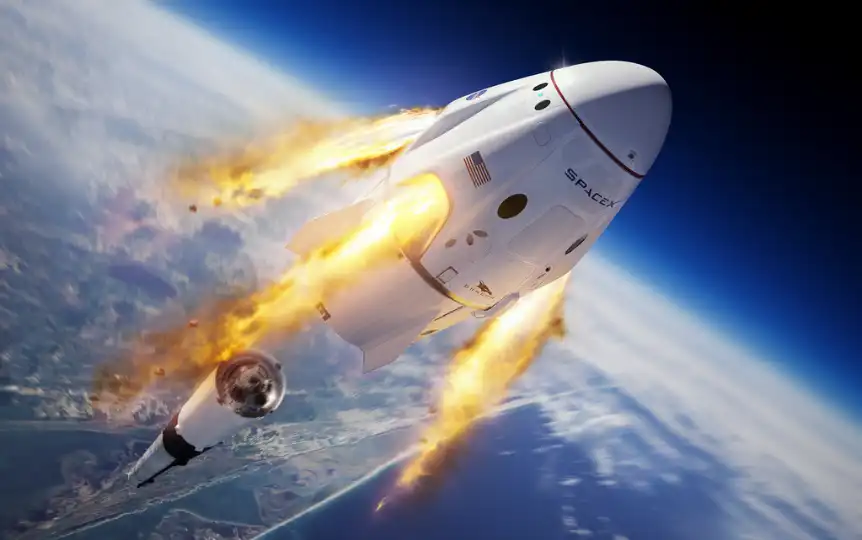
SpaceX, a company working to supply NASA with spacecraft, has successfully tested its emergency escape system. During the test, the capsule was safely carried away, while the main rocket exploded. This picture shows what the escape might look like from space.
(Source: SpaceX, via NASA Kennedy/Flickr.)
To launch spacecraft into space, rockets use several stages of “boosters”. Booster rockets push the main spacecraft up and then fall back to earth when their fuel is gone.
The first two minutes of a rocket’s flight is the most dangerous. That’s when the most pressure is on the rocket as it travels through the Earth’s atmosphere. Because this part of the flight is so dangerous, it’s important to have a system to keep astronauts safe if anything goes wrong.
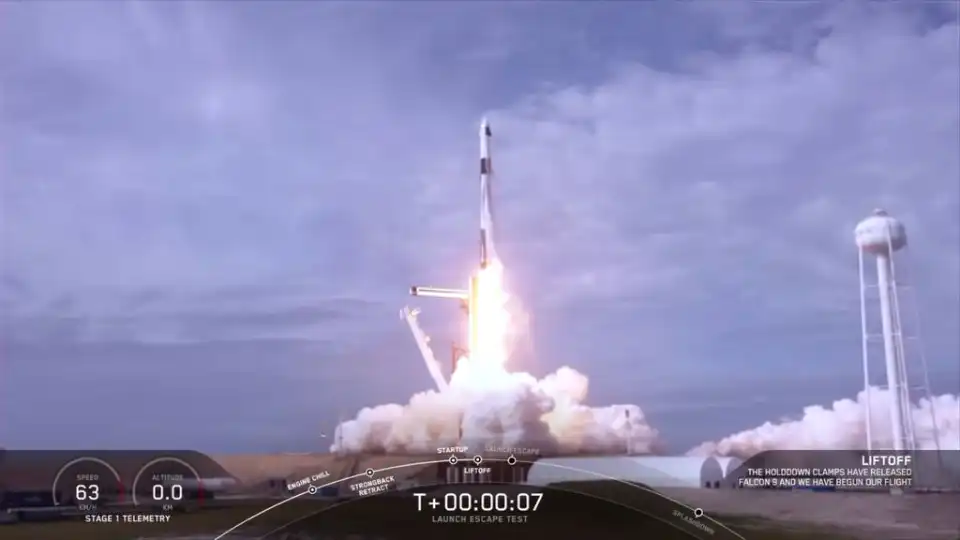
To launch spacecraft into space, rockets use several stages of “boosters”. Booster rockets push the main spacecraft up and then fall back to earth when their fuel is gone. Above, SpaceX’s Falcon 9 rocket is shown taking off for the test on Sunday.
(Source: NASA, Screenshot via YouTube.)
The flight on Sunday was designed to test SpaceX’s emergency escape system. There were no astronauts on the flight, but there were life-size crash test dummies with sensors to collect information about the conditions in the capsule.
During the flight, the Falcon 9 took off normally. But after 84 seconds, when the rocket was traveling 1,200 miles per hour (1,930 kilometers per hour), its engines were shut down. This was a pretend emergency.
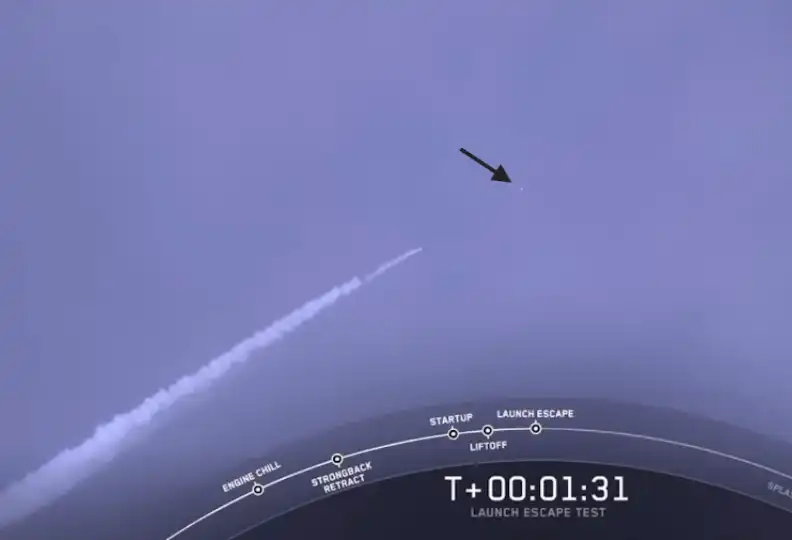
After 84 seconds, when the rocket was traveling 1,200 miles per hour (1,930 kilometers per hour), its engines were shut down. That’s when smaller rockets on the Dragon capsule carried the capsule (see arrow) away from the Falcon 9.
(Source: NASA, Screenshot via YouTube.)
At that point, eight smaller rockets (called thrusters) on the Dragon capsule carried the capsule away from the Falcon 9. The main rocket fell and exploded, but by that time, the Dragon capsule was safely away, about 27 miles (43 kilometers) above the earth.
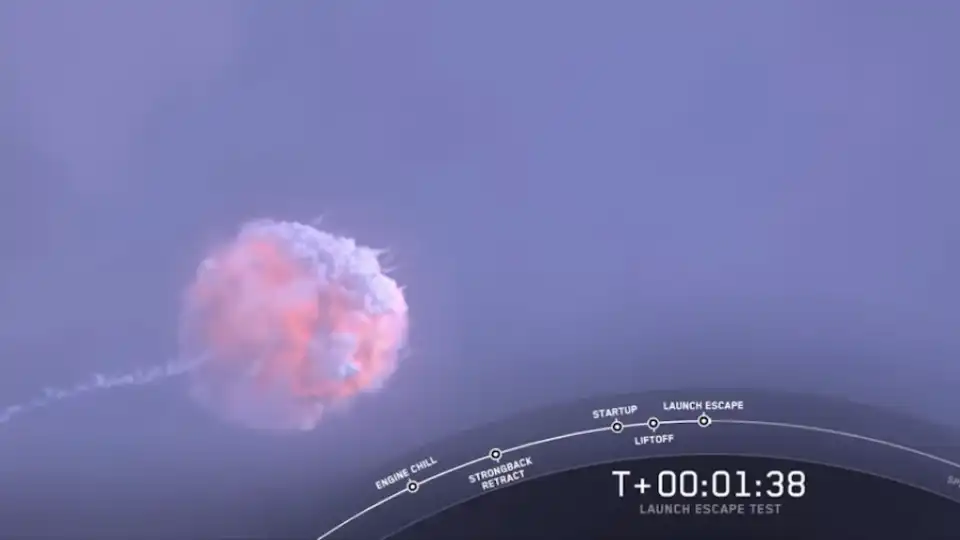
By the time the main rocket fell and exploded, the Dragon capsule was safely away, about 27 miles (43 kilometers) above the earth. The screenshot shows the Falcon 9 exploding.
(Source: NASA, Screenshot via YouTube.)
The Dragon capsule used small thrusters so that it was positioned correctly. Then two sets of parachutes opened up, slowing down the capsule as it returned to Earth. About nine minutes after takeoff, the capsule had splashed down safely in the Atlantic Ocean.
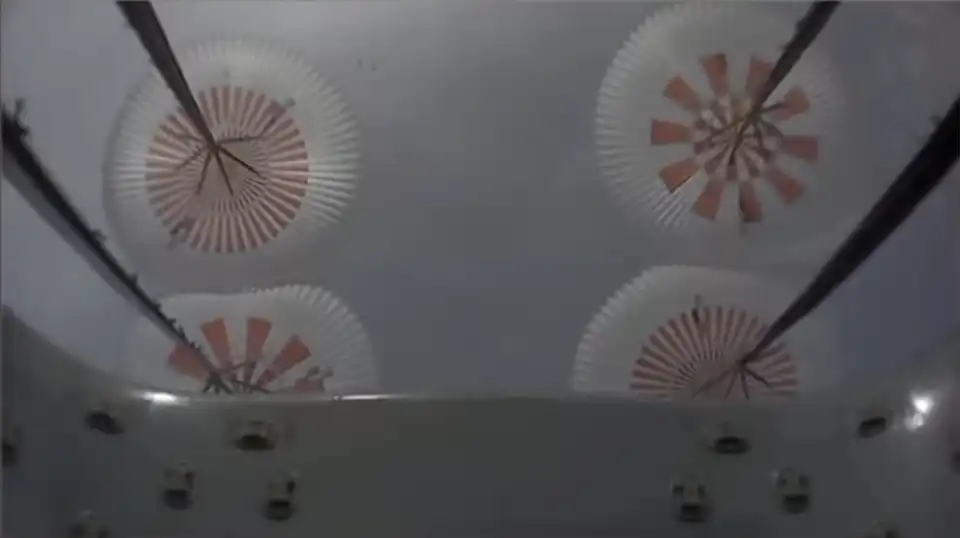
Two sets of parachutes opened up, slowing down the capsule as it returned to Earth. About nine minutes after takeoff, the capsule had splashed down safely in the Atlantic Ocean. The picture above was taken through a small window on the capsule.
(Source: NASA, Screenshot via YouTube.)
SpaceX’s system is important for NASA. The US space program used to make its own rockets. But since NASA stopped using the Space Shuttle in 2011, it has been counting on Russian rockets to bring astronauts to the International Space Station. The costs of using Russian rockets is now about $80 million per trip per astronaut.
In recent years, the US has been working with private companies to develop the rockets they need. Now, two companies have systems almost ready for use. SpaceX, a company created by Elon Musk, developed the system tested on Sunday. Airplane maker Boeing has also developed a system for NASA.
The escape test was the last test needed before SpaceX’s system can be used with astronauts.
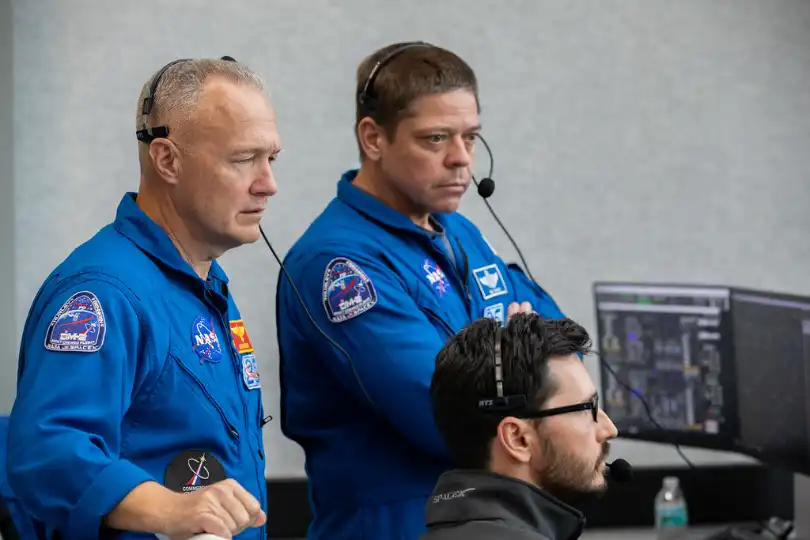
The escape test was the last test needed before SpaceX system can be used with astronauts. NASA astronauts Douglas Hurley, left, and Robert Behnken have been selected for the first flight. Above, the two watch Sunday’s launch.
(Source: NASA Kennedy, via Flickr.com.)
NASA believes a flight with astronauts could happen as early as March. Two NASA astronauts, Douglas Hurley and Robert Behnken have already been selected for that flight.
Having a way to get the crew off a rocket if something goes wrong is extremely important. In 2018 two astronauts were saved by a similar system when a Soyuz rocket had a problem as it launched.
Sourceswww.nytimes.com
arstechnica.com
www.abc.net.au
www.npr.org
www.bbc.com
www.dw.com
www.theverge.com
www.nytimes.com
Kennedy Space Center, Florida
View Larger MapShare:
This week marks 25 years of humans living in space. On November 2, 2000, three astronauts became the first full-time workers at the International Space Station. Since then, the ISS has never been empty.
Meteorite That Hit House Is Older Than Earth
NFK Editors - Aug 14, 2025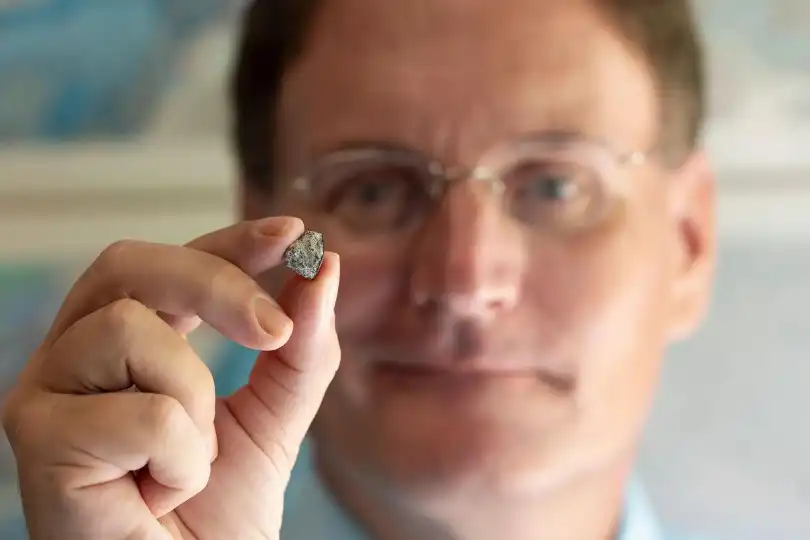
When a fireball fell through the sky in the southeastern United States on June 26, it caught the attention of people across seven states. It was a meteor breaking up as it fell through the Earth’s atmosphere. A small part of the space rock tore through a house in Georgia. Scientists now say the meteorite is older than the Earth.
Blue Origin Sends Six Women Into Space
NFK Editors - Apr 16, 2025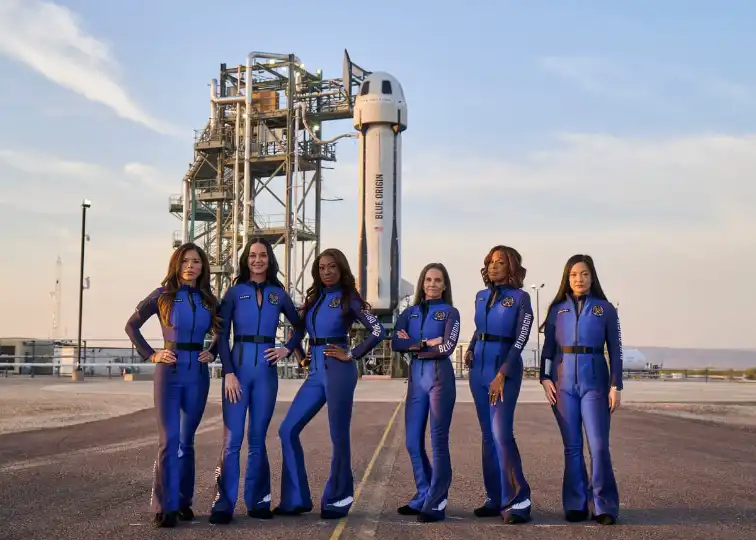
On Monday, the aerospace company Blue Origin launched its spacecraft RSS Kármán Line on a ten minute trip into space. The spaceship carried the first all-female crew to go into space since Russian astronaut Valentina Tereshkova’s solo mission in 1963.
Private Company Makes Perfect Moon Landing
NFK Editors - Mar 5, 2025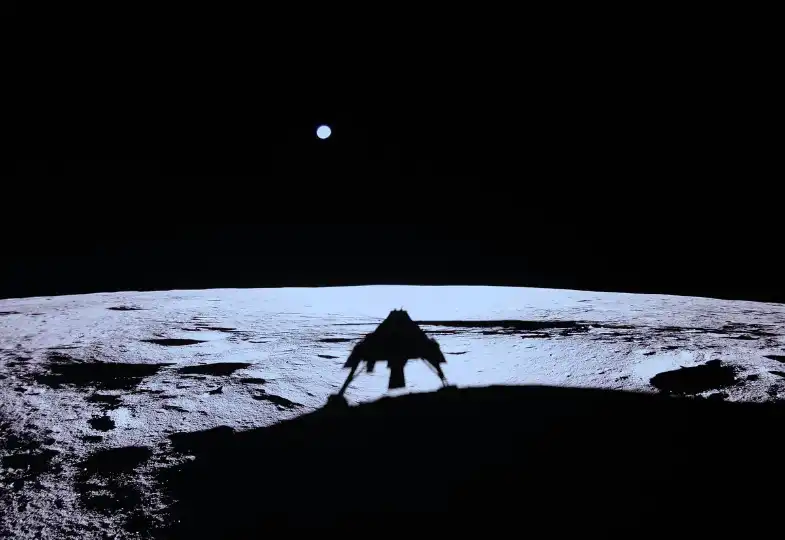
On Sunday, a company called Firefly Aerospace became the first private company to make a perfect landing on the moon. Firefly is working with NASA, and its spacecraft, Blue Ghost, is carrying out several experiments for the space agency.
advertisement