advertisement
Images Show Signs of New Planet Being “Born”
Images Show Signs of New Planet Being “Born”
NFK Editors - May 26, 2020A team of scientists believe they have captured the first picture of a planet being created. The new planet is far outside our solar system and is thought to be a gas giant like Jupiter or Saturn.
The planet in the picture is known as an “exoplanet”. That means a planet that isn’t going around our sun. Instead, it’s going around its own sun – a star known as AB Aurigae, which is about 4 million years old. Four million years may seem like a long time, but it’s young for a star.
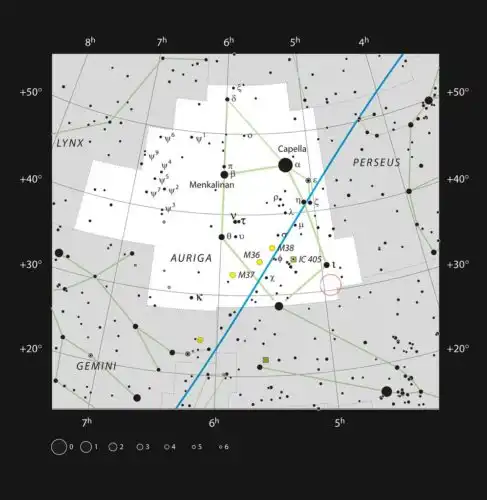
This map shows where AB Aurigae is (red circle). Other well-known stars and groups of stars are included to show where AB Aurigae can be found in the sky.
(Source: ESO, IAU and Sky & Telescope.)
AB Aurigae, is a star about 520 light years from Earth. That’s about 3,120,000,000,000,000 miles (3.1 quadrillion miles/5 quadrillion kilometers) away.
To create the pictures, a team of international scientists used European Southern Observatory’s “Very Large Telescope” (ESO’s VLT) in Chile. The VLT is made of four large telescopes which can work together as one even more powerful telescope.
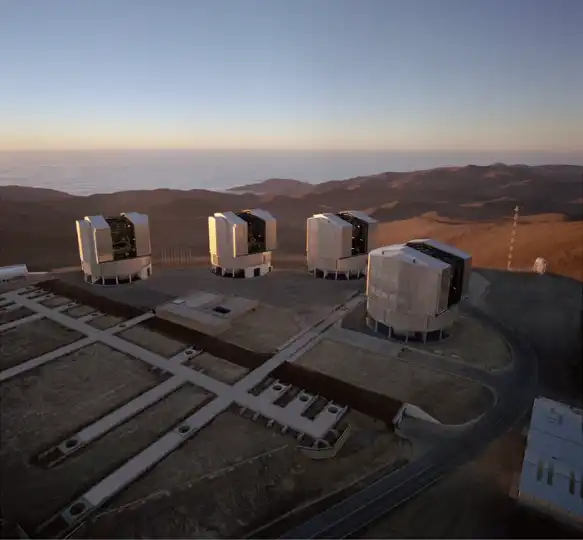
To create the pictures, a team of international scientists used European Southern Observatory’s “Very Large Telescope” (ESO’s VLT) in Chile. The VLT is made of four large telescopes which can work together as one even more powerful telescope.
(Source: ESO [CC BY], via Wikimedia Commons.)
The VLT has been used to study AB Aurigae before. Scientists are interested in AB Aurigae’s system because it is surrounded by a thick disc of dust and gas. These are the building blocks that planets are made of, and that’s something scientists are eager to study.
Anthony Boccaletti, who led the study, says,”Thousands of exoplanets have been identified so far, but little is known about how they form.”
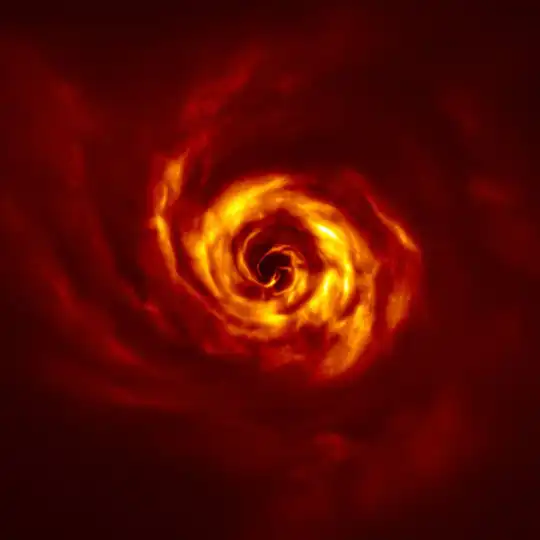
Scientists are interested in AB Aurigae’s system because it’s surrounded by a thick disc of dust and gas. These are the building blocks that planets are made of, and that’s something scientists are eager to study. This image shows the disc around AB Aurigae.
(Source: ESO/Boccaletti et al..)
Scientists believe planets form when the gas and dust begin to gather together. As this material spins, it disturbs the dust and gas around it, and some of what is stirred up gets added to the growing planet.
The pictures from AB Aurigae don’t actually show the planet. Instead, they show a “twist”. The scientists believe the twist is created by a new planet, which is leaving a path behind it, almost like the path of water left behind a motorboat. As the planet orbits the star, the path begins to form a spiral shape.
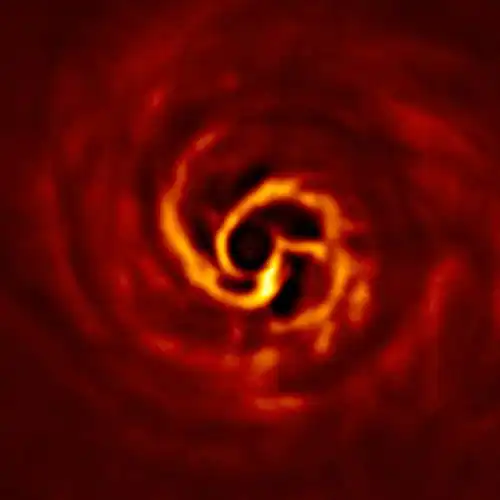
The pictures from AB Aurigae don’t actually show the planet. They show a “twist” (above, bright yellow). The scientists believe the twist is created by a new planet, which is leaving a path behind it. As the planet orbits the star, the path begins to form a spiral shape.
(Source: ESO/Boccaletti et al..)
The pictures are the most detailed pictures ever taken of AB Aurigae’s system. Normally, the light from the star itself is so bright that little else can be seen. To get the pictures, the scientists used a tool known as SPHERE*, which helped them block out the light from AB Aurigae and reveal the area around it.
The team believes that the exoplanet will be a gas giant, like Jupiter or Saturn. The twist is about as far away from AB Aurigae as Neptune is from our sun.
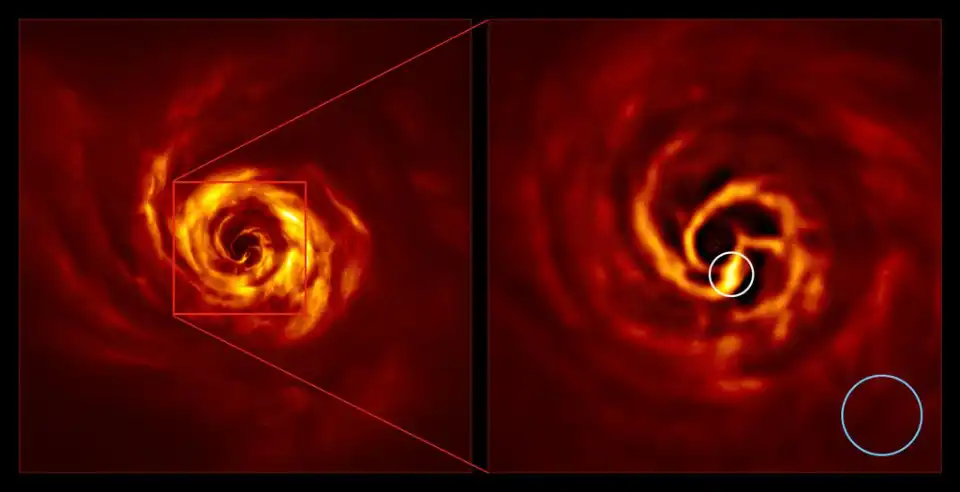
The twist is about as far away from AB Aurigae as Neptune is from our sun. The right-hand image zooms in on the area in the red square on the left-hand image. The ‘twist’ is circled in white. The blue circle is included to show the size of the orbit of Neptune.
(Source: ESO/Boccaletti et al..)
Though the scientists believe the twist is an exoplanet, they plan to continue to watch and track it. By keeping track of how quickly it moves and the path that it takes, they will be able to confirm for sure whether it is actually a planet.
*SPHERE stands for Spectro-Polarimetric High-contrast Exoplanet REsearch
Did You Know…?
The ESO is now building an “Extremely Large Telescope”, which will be even better for studying exoplanets.
Check Yourself
0/4
1. An _______________ is a planet that orbits a star outside our solar system.
2. AB Aurigae is about 4 million years old. Is that old or young for a star?
3. The scientists can't actually see the planet being created, but located it by the twist and spiral of its path.
True False4. The scientists expect the planet to be a gas giant, like Saturn or _______________.
Our sun is over 1,000 times older than AB Aurigae. How old would something 1,000 times older than you be? How about 1,000 times younger?
ResetSourceswww.cbc.ca
www.abc.net.au
www.smithsonianmag.com
www.vice.com
www.eso.org
Scientists have taken pictures of a star that is farther away than any single star ever seen. They were only able to see the star because gravity made it look bigger.
You might be interested in…
ISS Celebrates 25 Years of People Living in Space
NFK Editors - Nov 6, 2025
This week marks 25 years of humans living in space. On November 2, 2000, three astronauts became the first full-time workers at the International Space Station. Since then, the ISS has never been empty.
Meteorite That Hit House Is Older Than Earth
NFK Editors - Aug 14, 2025
When a fireball fell through the sky in the southeastern United States on June 26, it caught the attention of people across seven states. It was a meteor breaking up as it fell through the Earth’s atmosphere. A small part of the space rock tore through a house in Georgia. Scientists now say the meteorite is older than the Earth.
Australian Moths Use the Stars to Guide Them
NFK Editors - Jul 9, 2025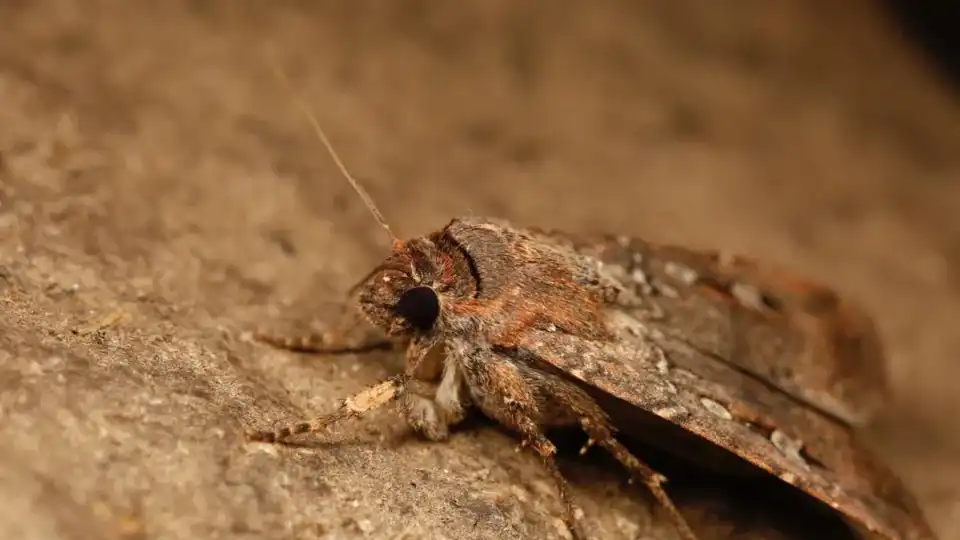
Scientists have made a surprising discovery about one of Australia’s migrating moths – Bogong moths use the stars to help guide them on their long trips across Australia. The moths are the first insects known to use the stars as a guide while migrating.
Vera Rubin Telescope Reveals Amazing Images
NFK Editors - Jun 25, 2025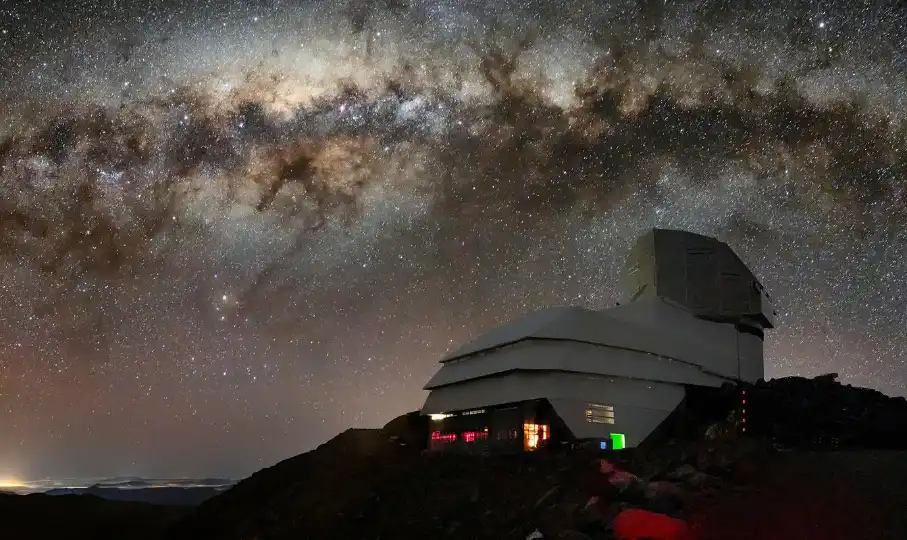
On Monday, scientists released the first pictures taken by the Vera C. Rubin Observatory in Chile. The observatory has a powerful new telescope that’s designed to take complete pictures of the southern night sky over the next ten years. It’s expected to bring huge changes to the way scientists study space.
advertisement