advertisement
Robot Lab Assistant Runs Its Own Experiments
Robot Lab Assistant Runs Its Own Experiments
NFK Editors - July 10, 2020Liverpool, England —(Map)
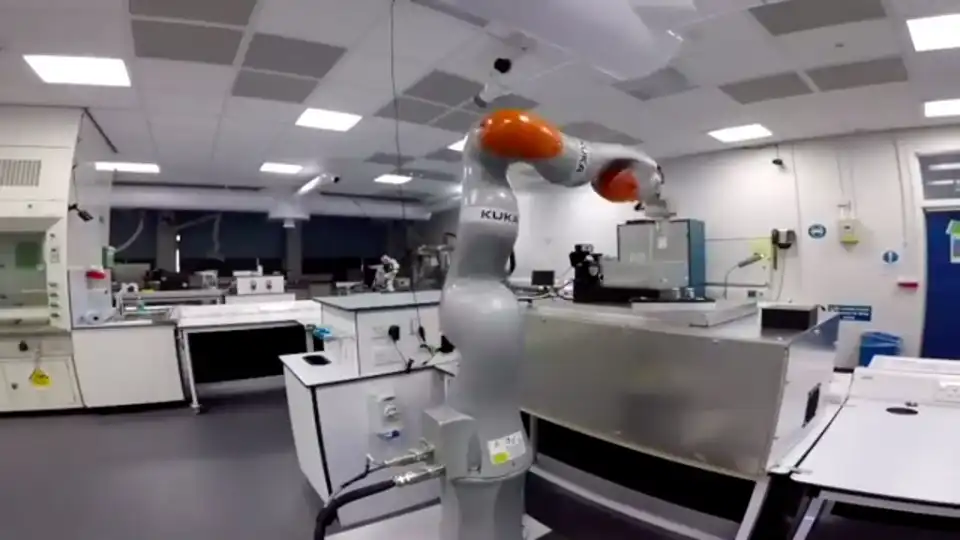
Scientists at the University of Liverpool (UL) have developed a robot that can run experiments on its own. The robot works tirelessly, stopping only long enough to recharge its batteries. Recently, the robot finished nearly 700 experiments in eight days.
It’s not new for labs to use robots. But earlier robots usually stayed in one place and did a single job over and over.
The UL robot is the opposite of that. The 5 foot, 7 inch (1.75 meter) robot is similar in size to a human. Though it weighs much more than most people – 882 pounds (400 kilograms) – it’s able to easily move around in the same sort of space as humans do.
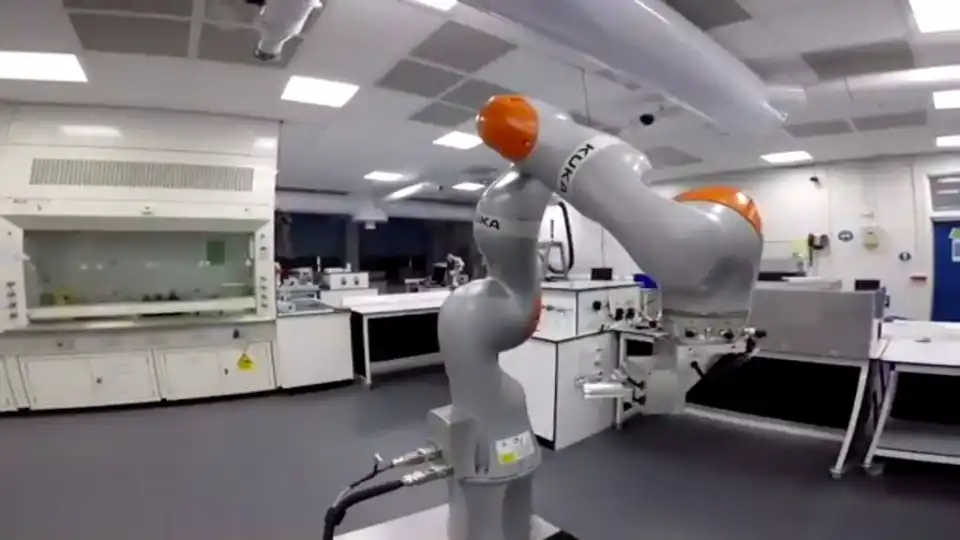
Scientists at the University of Liverpool (UL) have developed a robot that can run experiments on its own. Using a special laser system called LIDAR to guide itself, the robot is able to easily move around in the same sort of space as humans do.
(Source: University of Liverpool.)
It uses a special laser system called LIDAR to guide itself – even in the dark. Once it’s close to a work station, it can move into a more exact position through its touch sensors.
With one long arm which can turn in almost any direction, the robot is capable of using several different kinds of lab equipment. Some of the equipment has been changed slightly to make it easier for the robot, but basically, it’s the same equipment a human would use.
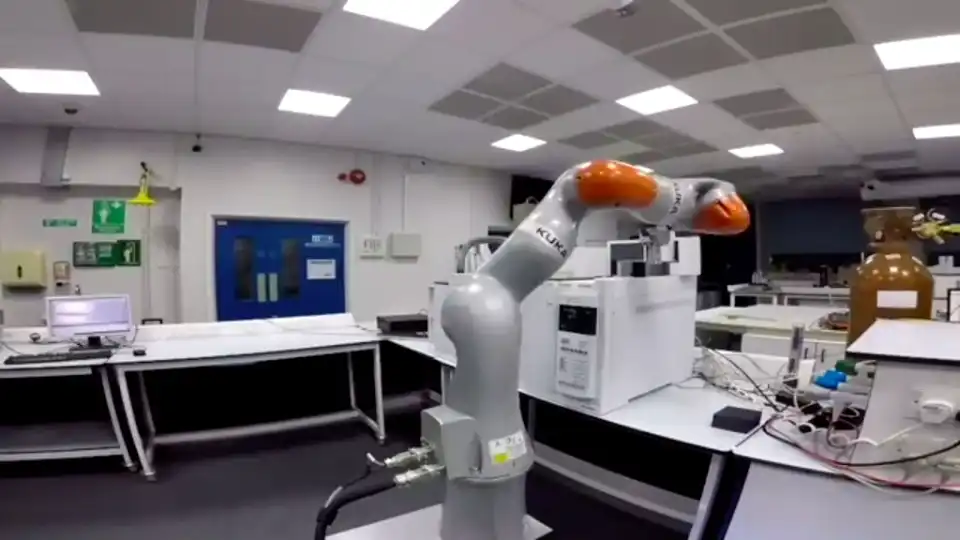
With one long arm which can turn in almost any direction, the robot can use several different kinds of lab equipment. Some equipment has been changed slightly to make it easier for the robot, but basically, it’s the same equipment a human would use.
(Source: University of Liverpool.)
What’s more, the robot can perform many different tasks, such as picking things up, setting them down, pushing buttons, pouring liquids, weighing and measuring things, and studying its results. The robot was built and programmed by Benjamin Burger, a Ph.D. student at the university.
Dr. Burger says it took a lot of effort to program the robot so that it can do things without making mistakes. That’s important because it’s meant to run for days without help. Once the programming is done, though, Dr. Burger says the robot makes fewer mistakes than a human.
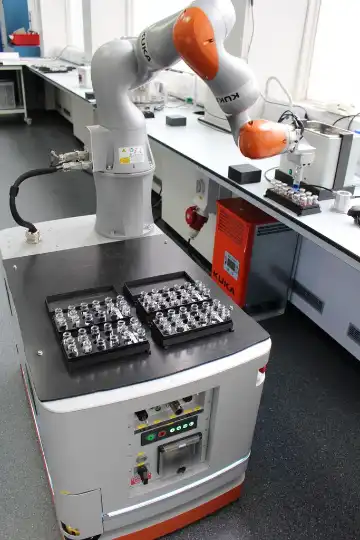
The robot can perform many different tasks, such as picking things up, setting them down, pushing buttons, pouring liquids, weighing and measuring things, and studying its results.
(Source: University of Liverpool.)
To test their robot, the scientists gave it a challenge: find a material which was good at producing hydrogen from water, using light.
The robot was programmed to understand the basic methods for the experiment, but it was given 10 different things it could change which could affect the results. That meant that the robot could choose from around 98 million different mini-experiments.
Over the next 8 days, the robot ran 688 experiments, always choosing its next experiment based on the results of the last one.
Over the next eight days, the robot ran 688 experiments, always choosing its next experiment based on the results of the last one. The robot ran for 172 hours, stopping for only a couple of hours each day to recharge its batteries.
(Source: University of Liverpool.)
The robot ran for 172 hours, stopping for only a couple of hours each day to recharge its batteries. To do the same amount of work would have taken a human several months.
Though the scientists ran the robot for eight days, its most successful result came on the third day of experimenting.
Andrew Cooper, who led the program says the robot is meant to help scientists, not replace them. He says, “…it frees up time for the human researchers to think creatively..
(Source: University of Liverpool.)
The UL robot wasn’t cheap – it cost around $125,000 and took years to program. But the scientists compare that to the cost of other laboratory equipment which they say can also be quite expensive. The fact that the robot can be used for many different purposes is a huge advantage.
Andrew Cooper, who led the program says the robot is meant to help scientists, not replace them. He says, “…it frees up time for the human researchers to think creatively.”
Check Yourself
0/4
1. The University of Liverpool's robot is different from earlier robots because it can move around and do many jobs.
True False2. The robot can guide itself safely even in the dark by using a special _______________ system called LIDAR.
3. The robot can only work with equipment that was specially designed for it.
True False4. How many experiments did the robot do in eight days?
88600400688Can you think of other areas where a robot with similar skills might be useful? Do you think such a robot would take away jobs or simply leave humans free for more creative work?
ResetSourceswww.theverge.com
www.newsweek.com
newatlas.com
news.liverpool.ac.uk
Liverpool, England
View Larger MapShare:
advertisement